Designing for better financial literacy
OnePay Finplan is a personal finance app that stays current with your financial spendings, stacks your money habits stack against official money spending standards, and shows you how much you can set aside to reach your financial goals.
This project is done in collaboration with a financial advisor at Scotiabank. OnePay Finplan is an independent project. It is not affiliated with, endorsed by, or built on any material belonging to Scotiabank.
Scope
End-to-end product design, 0 to 1
Product development into MVP
9-step financial intake user flow
Spending capture mechanisms
Functional display of goals, projections, and health score
Report generation ready for professional advisors
Design system
Marketing landing page
My Role
Product design lead. I own the product end-end. Flows, screens, feature implementation, visual design, and design system.
My Partner's Role
Financial advisor at Scotiabank. He owns the financial models, calculation of benchmarks, regulatory boundaries, and useful user intakes.

More money is not the answer to money problems. The answer is better money habits.
I always thought making more money is the answer to reaching a prosperous life. My business partner (financial advisor) had a different philosophy. He told me about a common trend he noticed in his clients that many high income individuals were in worst financial shape than mid income clients who simply planned better. This became the foundation of why we set out to make this app because we realized we can help people simply with better financial literacy. Reaching financial and lifestyle goals could be achieved much faster with better money habits instead of trying to earn more.

Quote from financial advisor
"You would be surprised how many rich people are in worst financial shape than mid income families. Its all about spending habits, not income."

OnePay Iconography
Every financial plan starts with a static form that doesn't evolve into a habit.
Objectives for OnePay
1
A financial tracking system that fall is line with the financial advisor form.
2
Making sure the tracking statistics evolve based on day to day habits, not just a one time capture like a form.
3
Putting 1 & 2 together to help users form habits that improve their financial health.
"Behaviour doesn't change at one moment. It changes with a subtle nudge at the moment of action"


What I worked from
A combination of advisory insights and tools, user research, competitor analysis.
A working financial advisory practice
A working professional in the field that has helped identified the core project issue and how we can design a solution within regulations and guidelines.
Real benchmarks and financial advisory tools
Real financial benchmarks and categories according to Canadian regulatory guidelines and CFP practitioner standards to do OnePay’s calculations.
Competitive analysis of top budget apps.
Deep teardown of top budget apps: Buddy, Simple Budget, and Fleur. Mapping out their core flows to find how they shaped their products. And identifying weaknesses we can tackle with OnePay.
Measuring against national standards rather than made up categories.
Why OnePay uses national standards
A
Users can get real spending thresholds based on national statistics based on their income and financial standings.
B
Creating financial standing reports that are compatible to be handed off to real financial advisors for further work.
Dashboard for adding expenses and comparing them to standard spending models
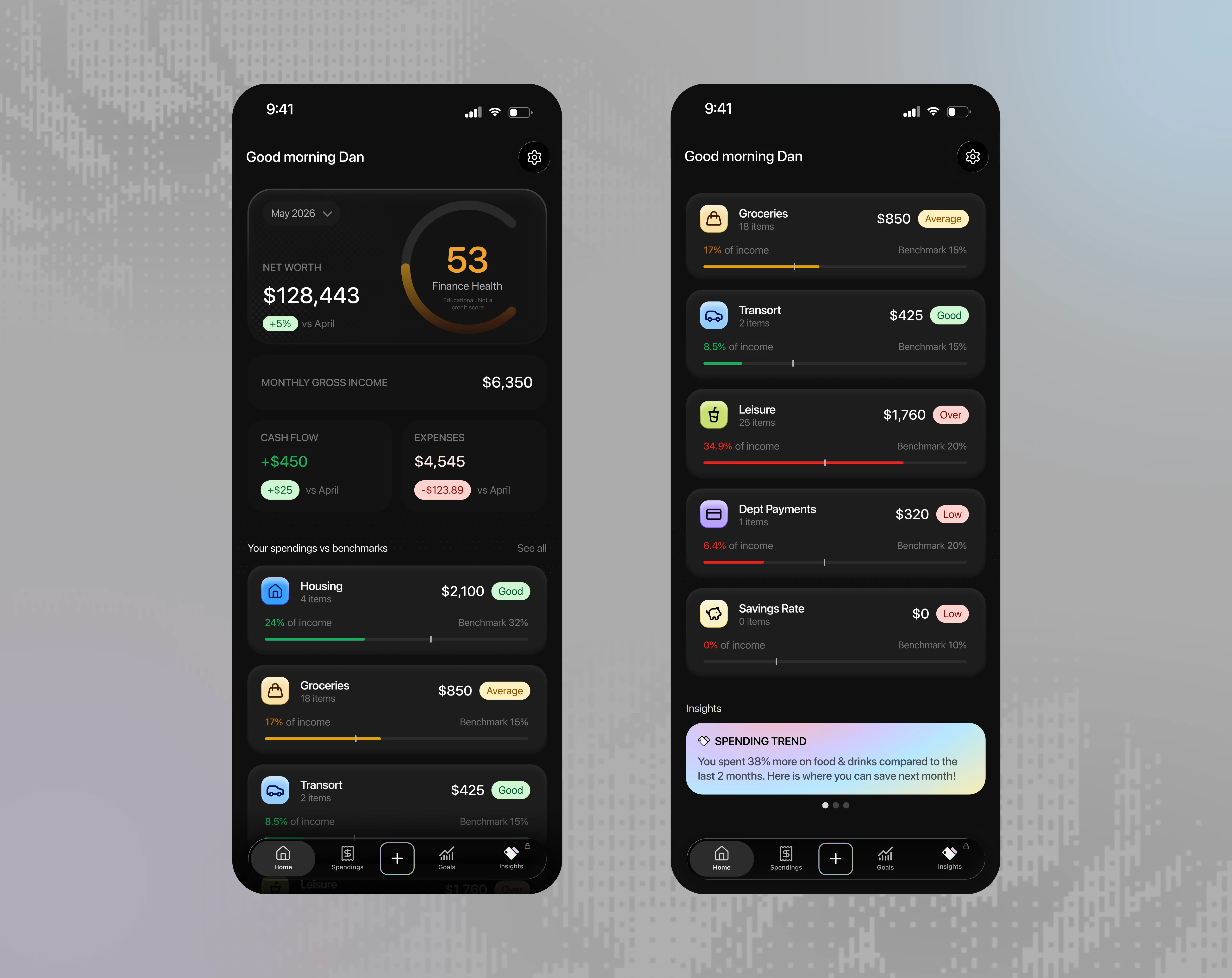


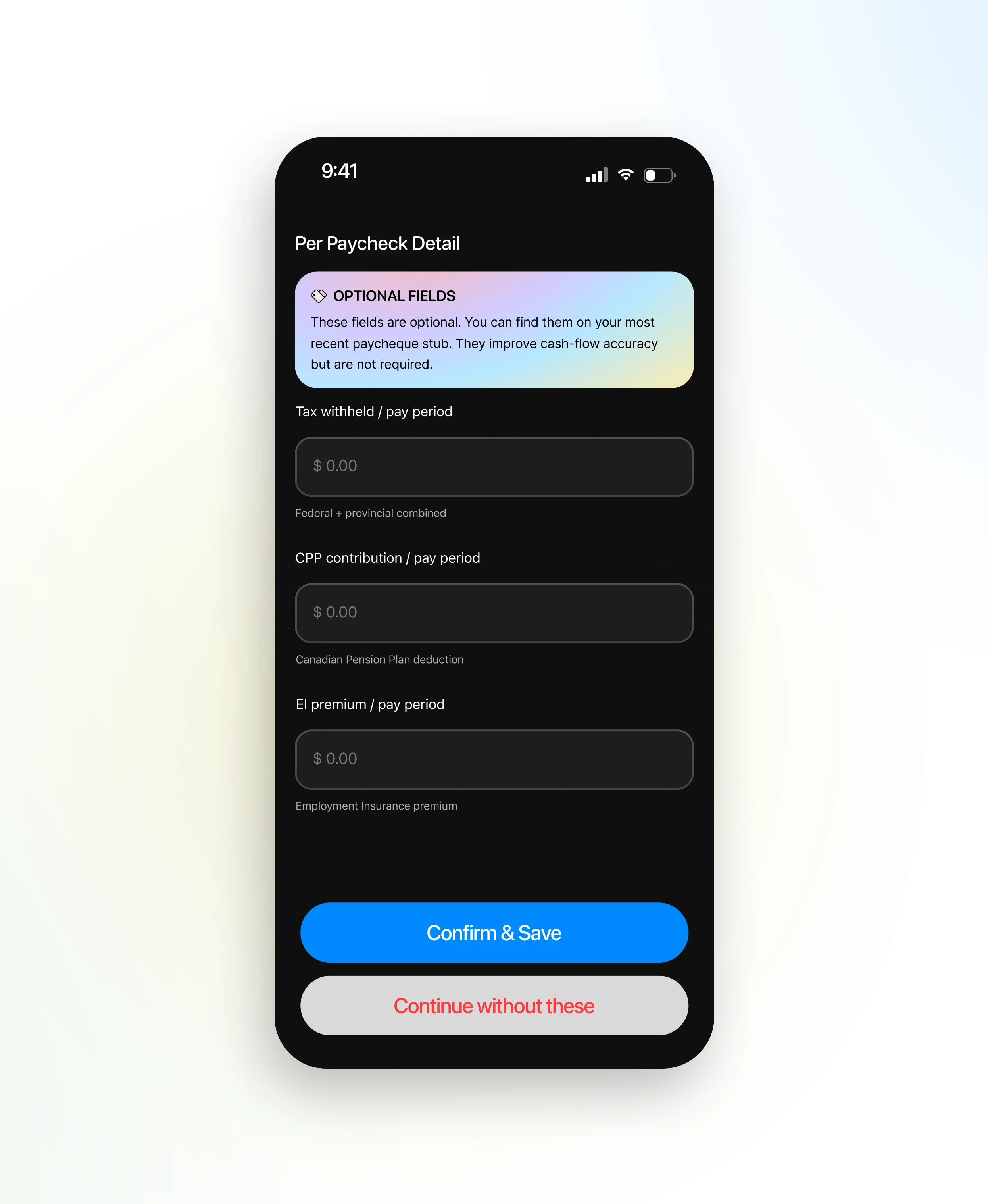
Setting goals and doing the calculations that lead to actually achieving them
Its easy for someone to say what they want. A house, a car, a wedding, a degree. But rarely do people actually calculate what it takes to achieve these goals through monthly contributions. OnePay gives users the tool to set goals with timelines to see how much monthly contribution is needed to get there.
Solution
Lets users set goals and see how they can get there with monthly contributions.
OnePay gives users 3 simple numbers
1. What the goal requires each month.
What the user’s income-spending balance leaves available for the goal.
The distance between 1 & 2
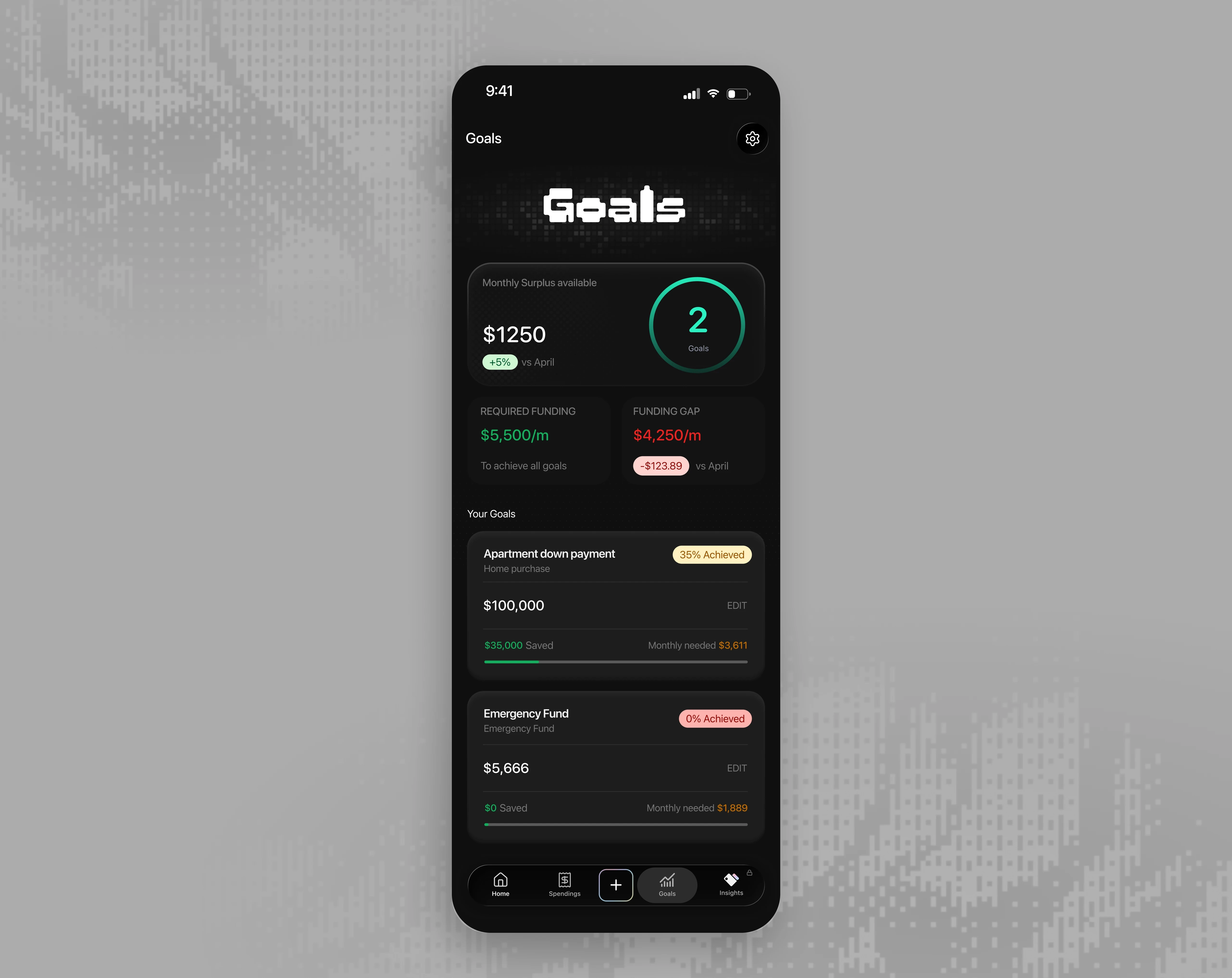
Goals dashboard with 2 goals set
Making reporting expenses easy to do during the act of spending.
Advisors see clients fill the report and forget about its results a few weeks after creating a plan. The results of the report simply live in a static sheet that gets outdated quickly and doesn’t turn into a habit.
We knew the key to making OnePay’s reports up to date and useful was to make an easy way to capture expenses the moment the expense is happening.
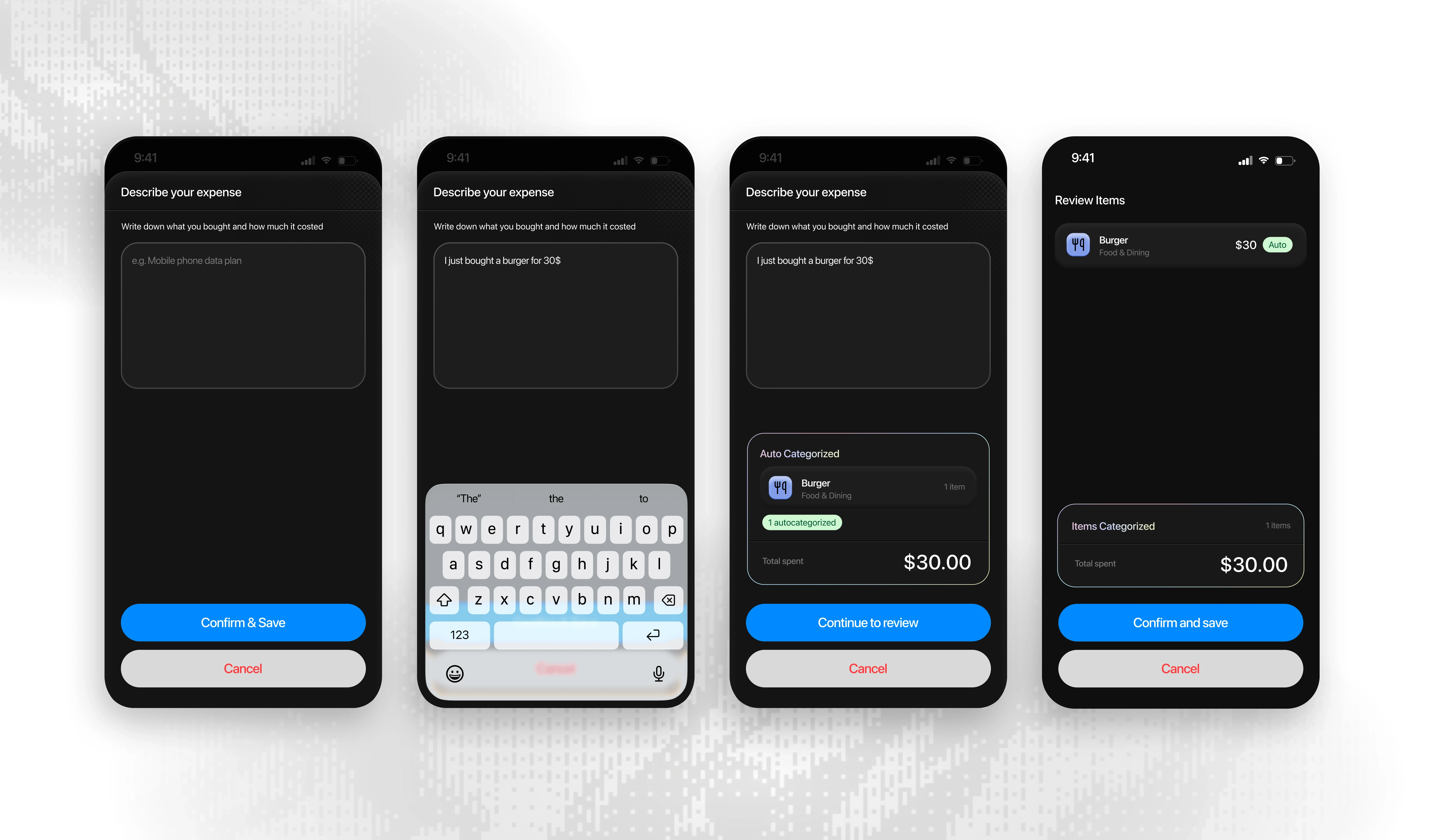
3 methods of adding expenses
1. Picture of receipts
Typing or speaking into chat interphase
Manual
Bank statement upload
Method 1: Picture of receipt for OnePay to analyze and auto categorize

Method 2: Describing expense in chat box for auto categorizing
Method 3: Manually adding expenses

Where I failed and what I would do differently
Initially, I designed the app to connect directly to apple's wallet app to track expenses. The idea was based on the app only visually keeping track of spendings and auto categorizing them as the user spends during day to day living.
After spending time designing around this mechanism, we discovered the app store's guidelines are tight and access to apple's IOS wallet app would be nearly impossible. We had to quickly rethink how to change our app to fit this constraint.
I came up with the 2 new methods mentioned above; taking pictures of receipts or describing the expense in natural language to a chat interphase for the app to analyze. Although these are less than perfect solutions, they are the best we could think of based on our constraints. Moving forward, I would better research feasibility of features before designing around it.

Annotated handoff. Search results at 15″ and 13″, with max-widths, sticky behaviour, and card constraints documented in the file.
“On a constrained product, verifying the constraint is the first design task, not a validation step at the end."
Designing for a better habit
OnePay is not meant to give financial advise and is not meant to fully replace financial managers. Its designed to give users financial literacy and guide them to better overall financial health and habits.
The app ends its function here and gives users all the tools they need to meet a professional financial advisor and take their finances to the next level. OnePay delivers the report needed as the first step to financial management, and gives you rough guidelines to follow and stay on top of financial plans.
Where the app ends
OnePay helps users learn better financial habits and nudge themselves towards better financial management. They will have all the tools they need to meet a professional advisor and take finances to the next level.